The first half of February was dominated by one milestone: we brought the site online. The homepage, landing, and blog are live for testing and early-access signups, and we’ve started to add the structure that will make the blog and content side of Apogee Watcher useful for our users and for search. Here’s what we built.
Site launch
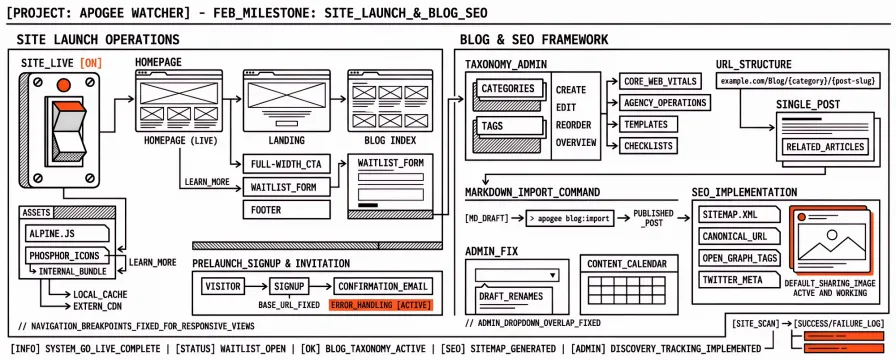
We flipped the switch. The homepage, landing, and blog are live with a full-width call-to-action, footer, and a waitlist form so you can register interest without committing to a full signup yet. We’re still building and testing—nothing is publicly launched—but the site is now the place where you can learn about the product and join the waitlist. We fixed navigation breakpoints so the menu behaves correctly on different screen sizes, tuned the body layout and background pattern, and made sure favicons and layout links work everywhere. If you’ve been waiting for a place to learn about the product and sign up for updates, that place is live.
We also tightened how we serve assets. Alpine.js and Phosphor Icons are now part of the app bundle instead of loaded from an external CDN, which improves reliability and keeps the number of third-party requests down. We added support for serving images from a CDN where needed, and we added a “Learn more” link and a small blog section on the homepage so visitors can go from “what is this?” to “tell me more” in one click. Prelaunch signup and invitation flows are in place: you can sign up for early access, and we can send you an invitation when your account is ready. Confirmation emails now use the correct base URL and we improved error handling so failed sends don’t leave you in the dark. If you signed up and didn’t get a confirmation, that’s the kind of thing we’re now catching and fixing.
Blog categories, tags, and SEO
We implemented categories and tags for the blog. Every post has one category and one or more tags, and we added the admin screens to manage them—create, edit, reorder, and see at a glance which posts use which taxonomy. On the front end we added category and tag index pages and made sure the blog index and single-post pages show related posts and use a consistent “Blog/” prefix in the URL so the structure is clear. Over time you’ll be able to browse by topic, for example Core Web Vitals, agency operations, or templates and checklists, and find related articles without hunting.
We built a command to import blog posts from markdown drafts. That lets us write and review in markdown and then publish into the live blog without copy-pasting—faster iteration and fewer formatting bugs. On the SEO side we added a main sitemap at /sitemap.xml, canonical URLs so search engines know which URL is the “main” one for each page, and a default sharing image plus Open Graph and Twitter meta tags so links look good when shared. We fixed a dropdown overlap in the admin so the UI doesn’t get in the way when you’re editing. We also updated our content marketing and competitive analysis notes and added a content calendar and draft renames so we can plan and publish posts in a consistent way. The goal is a blog that’s useful for our users and discoverable for people searching for performance monitoring and related topics.
Discovery and what’s next
We documented how the admin will track discovery attempts—when we automatically scan a site for pages to monitor, we want to see what succeeded and what failed so we can debug and improve. The missing discovery-related files are in place so the feature can be implemented cleanly. Once that’s in, you’ll be able to see which URLs we found (or didn’t) when you add a new site, which makes it easier to trust the system and fix configuration when something goes wrong. We updated our roadmap, content marketing, and social planning so the next few months are aligned—more posts, more clarity on positioning, and a steady cadence of updates.
Launch week also meant a lot of small fixes: meta descriptions and accessibility tweaks, lazy-loading for reCAPTCHA where we use it, and alignment between the early-access and prelaunch views so the experience is consistent whether you hit the site from an ad or from the blog. We’re treating the first few weeks after bringing the site online as a stabilisation window—fix what breaks, improve what’s confusing, and then layer on the next big features.
In the second half of February we’re focusing on RSS so you can subscribe to the blog, surfacing discovery attempts in the product so you can see what we found (or didn’t), and polishing the taxonomy and blog UX further. More on that in the next changelog.