Your Question: Do CWV Actually Affect Rankings?
You're investing time in performance. You need to know: will fixing Core Web Vitals actually move the needle for rankings? And what do you tell clients when they ask? Without a clear answer, you're either under-investing (and losing rankings to faster competitors) or over-promising (and disappointing when CWV fixes don't magic you to page 1). Here's what the data actually shows — so you can prioritise CWV work and report to clients with confidence.
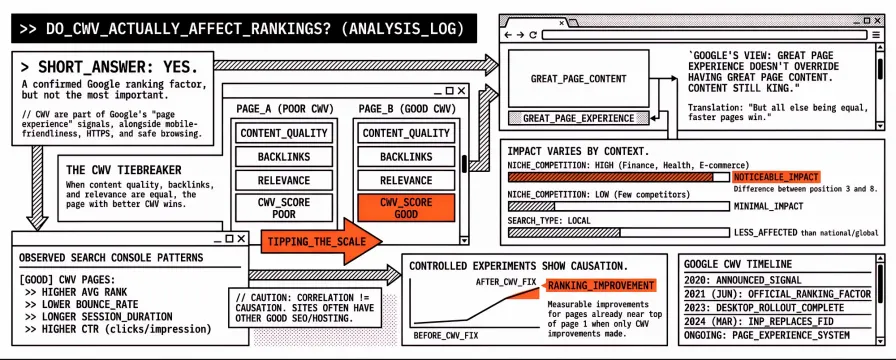
The short answer: Yes, CWV are a confirmed Google ranking factor. They're not the most important one, but they matter. For a primer on what LCP, INP, and CLS measure, see What Are Core Web Vitals?; for setting and enforcing thresholds, see The Complete Guide to Performance Budgets.
CWV are part of Google's "page experience" signals, alongside mobile-friendliness, HTTPS, and safe browsing. They serve as a tiebreaker: when two pages have similar content quality, backlinks, and relevance, the one with better CWV gets the edge.
What the data consistently shows is that CWV matter most in competitive niches where many pages target the same keywords with similar content. In those situations, performance can be the difference between position 3 and position 8.
What Google Has Actually Said
Google has been clear about CWV's role in ranking:
2020: Announced Core Web Vitals would become a ranking signal
2021 (June): Rolled out the page experience update, officially making CWV a ranking factor
2023: Completed the desktop rollout
2024 (March): Replaced FID with INP as a Core Web Vital
Ongoing: CWV remain part of the page experience ranking system
Google's own documentation states: "While page experience is important, Google still seeks to rank pages with the best information overall, even if the page experience is subpar. Great page experience doesn't override having great page content."
Translation: Content is still king. But all else being equal, faster pages win.
What the Data Shows
Search Console Data Patterns
Across Search Console datasets we've reviewed (our own accounts and public case studies), a few patterns show up repeatedly:
Pages with "Good" CWV tend to:
Rank higher on average than pages with "Poor" CWV
Have lower bounce rates
Have longer average session durations
Generate more clicks per impression (higher CTR)
The effect size varies by niche:
In highly competitive niches (finance, health, e-commerce), CWV impact is more noticeable
In low-competition niches with few competing pages, CWV impact is minimal
Local search is less affected than national/global search
The Correlation vs Causation Problem
Important caveat: much of the data shows correlation, not pure causation. Sites with good CWV also tend to have better technical SEO overall, faster hosting, more modern code, and often better content. The CWV scores may be a proxy for overall technical quality rather than the sole cause of ranking differences.
That said, controlled experiments (where only CWV improvements were made with no content changes) have shown measurable ranking improvements, particularly for pages already near the top of page 1. Google has published case studies and guidance on the page experience update — see Google's page experience documentation for official details. Search Console's CWV report groups URLs by status (Good, Needs Improvement, Poor) but doesn't show exact ranking impact; use it to identify problem pages, not to attribute specific ranking changes.
Practical signal: Run the "Page experience" report in Search Console. If you have URLs in "Poor" status, those are candidates for optimisation. Many sites see improved rankings after moving URLs from Poor to Good — the effect is most visible when you're already ranking on page 1 and competing with similar-quality content from other domains.
How Each Metric Affects SEO
LCP and SEO
LCP is the most impactful CWV metric for SEO because it directly measures how fast users see meaningful content. Google cares about this because:
Slow LCP = users see a blank or incomplete page for too long
Users (and Google) associate slow loading with low quality
Pages with LCP > 4s have significantly higher bounce rates
SEO priority: High. If you only fix one metric, fix LCP.
INP and SEO
INP is newer (replaced FID in March 2024) and its SEO impact is still being understood. However:
INP measures what users feel after the page loads — responsiveness
Poor INP doesn't affect initial page rendering but does affect user satisfaction
Google's emphasis on INP signals they expect interactivity to become more important
SEO priority: Medium. Important for interactive pages (e-commerce, web apps) but less critical for content-only pages.
CLS and SEO
CLS affects SEO indirectly by impacting user experience signals:
Layout shifts cause accidental clicks and increase bounce rates
Users who experience shifts are less likely to engage with the page
CLS doesn't affect page load speed but does affect user trust
SEO priority: Medium. Easy to fix and worth fixing, but less directly tied to ranking than LCP.
The CWV / SEO Flywheel
Good CWV create a positive feedback loop:
Better CWV → Better user experience → Lower bounce rate →
Longer sessions → Stronger engagement signals →
Better rankings → More traffic → More data to optimise
Poor CWV create the opposite loop:
Poor CWV → Bad user experience → Higher bounce rate →
Shorter sessions → Weaker engagement signals →
Lower rankings → Less traffic → Less motivation to fix
This is why CWV impact compounds over time. A site that fixes its CWV issues early gets the flywheel spinning in the right direction, while competitors with poor CWV fall further behind.
Field Data vs Lab Data for SEO
Google uses field data (real user data from CrUX) for ranking decisions, not lab data (Lighthouse scores). This distinction matters:
Your Lighthouse score can be 95, but if real users on slow connections experience poor LCP, Google uses the field data
Field data requires a minimum traffic threshold. Low-traffic pages may not have field data, in which case Google uses other signals
Field data is updated monthly with a rolling 28-day window. Improvements take about a month to reflect in CrUX data
What this means for monitoring: You need to track both lab data (for debugging and proactive optimisation) and field data (for understanding what Google sees). Lab data tells you what to fix. Field data tells you if your fixes are working at scale. Apogee Watcher displays both in every test result — Lighthouse lab metrics and CrUX field data — so you get the full picture without switching tools.
How Long Does It Take to See SEO Impact?
Realistic timelines after fixing CWV issues:
Phase | Timeline | What Happens |
|---|---|---|
Fix deployed | Day 0 | Lab scores improve immediately |
Field data updates | 28 days | CrUX data reflects the improvement |
Google processes | 1-2 months | Google's systems incorporate the new field data |
Ranking impact visible | 2-3 months | Ranking changes start appearing in Search Console |
Full impact | 3-6 months | Ranking stabilizes at new position |
Key insight: CWV fixes are not instant ranking boosts. They're a slow burn. If someone promises overnight SEO results from CWV optimisation, they're overselling.
Industry-Specific SEO Impact
E-Commerce
Impact: High. Competitive landscape means CWV is often the tiebreaker
Key metric: LCP on product pages, INP on category pages with filters
Risk: Poor CWV on product pages can push you below competitors in Shopping results
Professional Services (Law, Finance, Health)
Impact: High. YMYL (Your Money or Your Life) content is under extra scrutiny
Key metric: LCP and CLS on landing pages
Risk: Google holds YMYL content to higher quality standards, including page experience
Content / Media
Impact: Medium. Content quality matters more, but CWV affects engagement signals
Key metric: CLS (ad-related shifts) and LCP (article body rendering)
Risk: Ad-heavy pages often have poor CLS, which hurts user experience and engagement
Local Business
Impact: Low to medium. Local pack results are driven more by proximity and GMB signals
Key metric: LCP on the homepage and contact page
Risk: Low, but not zero — mobile CWV still matters for mobile searchers
SaaS / B2B
Impact: Medium. Long sales cycles mean users interact with multiple pages
Key metric: LCP on landing pages, INP on interactive demo pages
Risk: Poor CWV on landing pages increases cost per acquisition
What to Do About It
If Your CWV Are Already Good
Maintain them. Set up automated monitoring so you catch regressions before they affect rankings. Performance degrades gradually — the sites that maintain strong CWV are the ones actively monitoring.
If Your CWV Need Improvement
Prioritize fixes by business impact:
Fix LCP on your highest-traffic, highest-conversion pages first
Fix CLS across the site (usually quick wins)
Improve INP on interactive pages
Set up monitoring to prevent regressions
Track field data in Search Console to verify improvements
If You're an Agency
CWV optimisation is a service you can sell. Clients understand "your website is slower than your competitors and it's hurting your Google rankings." Performance monitoring and ongoing optimisation can be a recurring revenue stream.
What to tell clients when they ask about CWV and SEO: "Core Web Vitals are one of many ranking factors. Google uses them as a tiebreaker when pages are otherwise similar. Fixing CWV won't magically jump you to page 1, but it protects you from losing rankings to faster competitors and improves the experience for users who do find you. It's table stakes, not a silver bullet."
FAQ
Can good CWV alone get me to page 1?No. CWV are one signal among hundreds. You still need relevant content, quality backlinks, and strong technical SEO. CWV help you compete once you have those fundamentals in place.
My competitor has worse CWV but ranks higher. Why?They likely have stronger signals in other areas: better content, more backlinks, higher domain authority, more relevant topical coverage. CWV is a tiebreaker, not a trump card.
Should I focus on mobile or desktop CWV for SEO?Mobile. Google uses mobile-first indexing, so your mobile CWV scores are what count for ranking.
Do CWV affect all types of search results?CWV are most impactful for standard organic results. Their influence on featured snippets, knowledge panels, and local pack results is less documented.
What you can achieve: You can prioritise CWV with confidence — knowing when they'll move the needle and when they're table stakes — and show clients why monitoring and fixing performance protects their rankings. No more guesswork; just clear thresholds and evidence-based decisions.
For a dated roundup of Watcher lab cohorts and public field context, see 40+ Core Web Vitals Statistics for 2026.
Monitoring Core Web Vitals for SEO shouldn't be a manual process. Apogee Watcher automates PageSpeed testing across all your sites — with lab and real-user (CrUX) metrics in every test — and alerts you when metrics cross thresholds. Join the waitlist for early access.