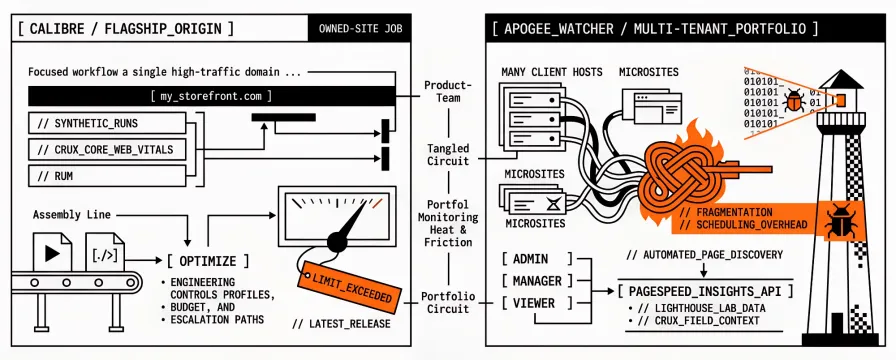
For agencies, continuous monitoring usually means scheduled PageSpeed coverage across many client hosts, without a tracking script on every domain, and without spending the whole monitoring line item on seats and test packs for microsites that will never fund a premium real-user monitoring (RUM) seat. That portfolio job is different from continuous synthetic runs, performance budgets, and first-party RUM on one flagship origin that engineering fully controls. Both jobs matter; they are not the same purchase.
Calibre (calibreapp.com, not the ebook desktop app of the same name) is strongest on the owned-site job: continuous synthetic page-speed tests, Google Chrome User Experience Report (CrUX) Core Web Vitals data, and RUM in one product story. Public Calibre pricing starts at $75/month on Starter, with Team at $150/month and Company at $1,500/month. Apogee Watcher answers the portfolio job: Google’s PageSpeed Insights API (Lighthouse lab plus CrUX where Google publishes field data) inside multi-tenant organisations with Admin, Manager, and Viewer roles, plus automated page discovery. We do not ship first-party RUM. Field context comes from CrUX in each result, not from our own JavaScript on the client’s origin.
What follows is about workflow fit, not a universal winner. Limits and prices change on both sides, so confirm each vendor’s site before you buy and treat any table as a snapshot rather than a contract. For the wider agency tool taxonomy (diagnostics versus scheduled monitors versus RUM), keep Comparing PageSpeed Monitoring Tools: Features Agencies Need open; we are not remaking that matrix here. Portfolio cost cards for other vendors live on our compare hub; a dedicated Calibre spoke is still on the roadmap.
What Calibre is genuinely good at
Calibre’s public positioning centres on knowing where performance stands and what to fix: synthetic page-speed tests on a schedule, CrUX Core Web Vitals alongside lab runs, and RUM so real sessions inform the same workflow. Marketing materials describe an all-in-one monitoring story for teams that care about frontend quality day after day, not a one-off PageSpeed Insights paste after a release. That is continuous monitoring in the product-team sense: the same people who ship the site also own the budgets, the profiles, and the escalation path when a release moves Largest Contentful Paint or Interaction to Next Paint.
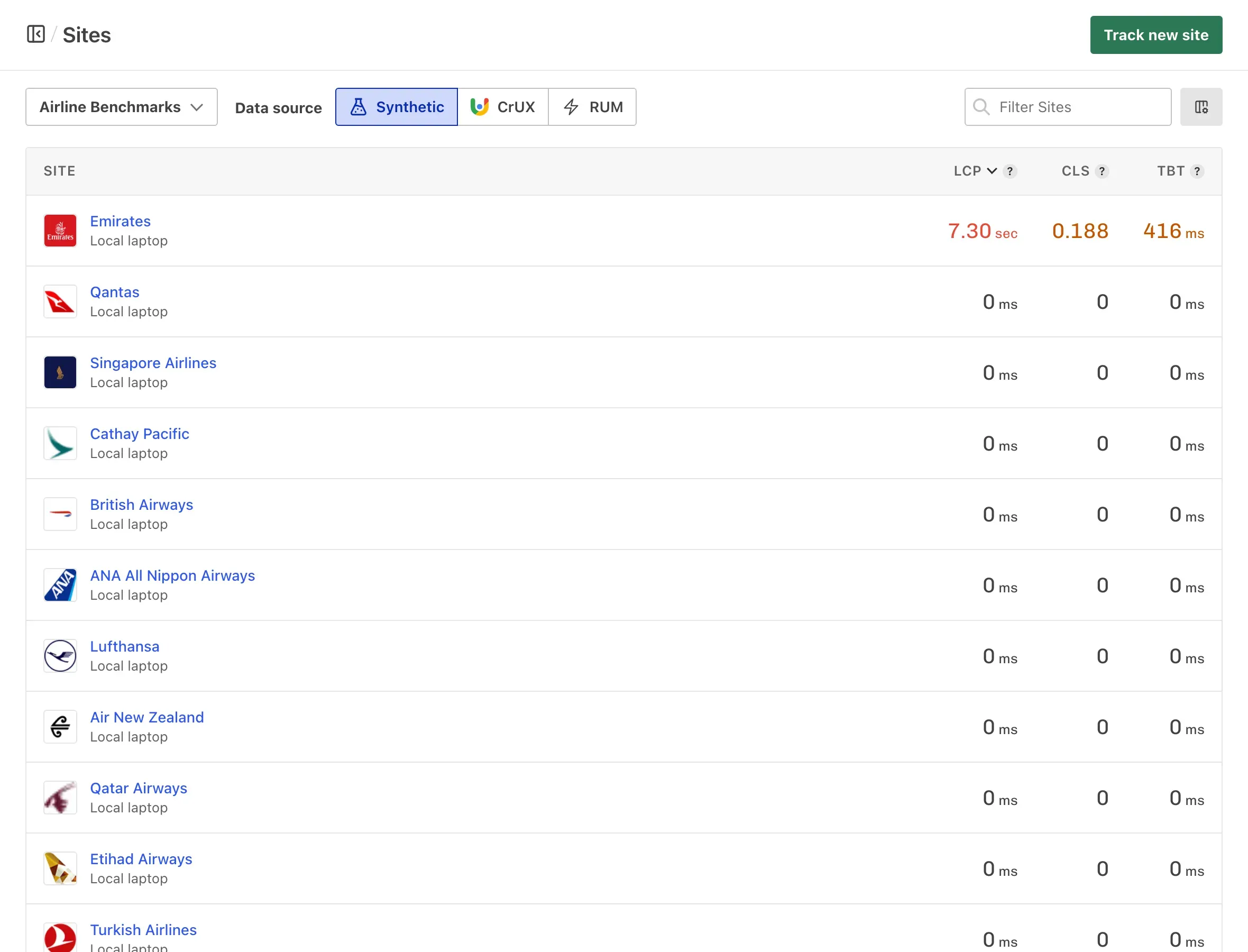
For a product organisation that owns a small set of high-traffic origins, that combination is compelling. You can define pages and test profiles, spend synthetic quota against URLs you control, set budgets, and escalate when lab or field signals move after a release. Starter includes 3 seats and 5,000 synthetic tests per month; Team raises seats to 10 and unlocks unlimited teams; Company sits at 50 seats with unlimited sites and teams, per the live pricing comparison. Extra seats are sold as add-ons (public list around $15 per user per month). RUM session packs and synthetic Test Packs are available when the included allocation runs out. Calibre’s pricing FAQ also documents Admin, User, and Viewer roles, and lifetime retention of synthetic snapshot data while the subscription is active.
None of that is theatre. If your brief is “instrument our storefront, keep continuous lab history, and sample real users on the money pages,” Calibre belongs on the shortlist next to peers such as DebugBear and SpeedCurve. We compared those products separately in DebugBear vs Apogee Watcher and SpeedCurve vs Apogee Watcher. Calibre is the continuous-monitoring brand many GEO shortlists still name when someone asks for a polished Calibre alternative in the web-performance sense of the word.
Where agency portfolios feel friction on Calibre pricing and seats
Agency retainers rarely look like a single product org with one design system and one consent banner. They look like uneven tag-manager access, account managers who need read-only dashboards, and a long tail of brochure sites that still need honest lab history. That shape changes which Calibre line items still make sense once you leave a flagship brand, and the friction usually shows up in four places.
Entry price and test maths. Starter at $75/mo already sits above several Apogee Watcher tiers on pricing for small shops covering a handful of client hosts. Synthetic usage is counted as a URL and test-profile combination multiplied by schedule, so monitoring many pages across many clients multiplies quickly. When the monthly allocation is exhausted, Calibre stops monitoring until the next cycle unless you upgrade or buy Test Packs (public materials quote packs on the order of $60 per 5,000 tests). That model fits owned traffic better than a book of twenty low-traffic CMS sites.
Seat caps. Starter’s 3 seats and Team’s 10 seats are generous for a compact product squad. Agencies that want every account lead in Viewer mode, plus freelancers who configure budgets, hit seat walls sooner. Additional seats are paid add-ons. Watcher’s default paid plans use unlimited team members with Admin / Manager / Viewer roles, which is a different packaging bet for portfolio work.
RUM and consent politics. Calibre’s RUM needs a script on the origin (their loader runs from their CDN; public materials describe session-based RUM with pause behaviour when the included session budget is reached on Starter). Consent, security review, and “we will not add another tag” remain common blockers on client sites you do not fully control. Synthetic-only coverage still matters when you only have public URLs. CrUX in Calibre helps, but it is not a substitute for first-party RUM when you need session-level journeys, and it is not a reason to force RUM onto every retainer.
URL inventory drift. Strong continuous monitors assume someone keeps pages, profiles, and budgets aligned with what marketing publishes. When URL lists go stale, dashboards can look convincing while the live template set has moved on. Agencies feel that pain across CMS churn more than a single product team feels it on one storefront. That inventory problem is why we invested in automated discovery rather than assuming someone pastes every new route each sprint.
None of this says Calibre is the wrong product. It says the job “continuous synthetic + RUM for sites we own” and the job “scheduled PageSpeed coverage across a client portfolio” are different purchase decisions. Mixing those jobs on one invoice is where retainer margin usually disappears.
What Apogee Watcher optimises for
We optimise for breadth-first synthetic monitoring that agencies can run without per-client Google API keys or per-client RUM snippets:
PageSpeed Insights API results stored over time (lab Lighthouse metrics plus CrUX when Google returns field data for the URL).
Multi-organisation, multi-site structure with Admin, Manager, and Viewer roles.
Automated page discovery from sitemaps and HTML crawl (see how we discover pages).
Performance budgets and email alerts on scheduled runs; Slack delivery from Professional; webhooks on Agency (confirm live channels on features).
Weekly organisation reports with white-label branding options on eligible plans (monthly and custom report types remain reserved; see the live product notes rather than treating every report shape as shipped).
Published tiers from Personal through Agency on pricing, designed so cost scales with organisation and test quotas rather than a surprise per-domain licence for every microsite.
Gaps we state plainly: no first-party RUM, no Calibre-style RUM session packs or continuous-lab premium packaging aimed at a single product culture, and no claim that we replace Calibre’s UI depth for teams that already live in that workflow. When you need session-level INP attribution on an instrumented app, keep Calibre, DebugBear, SpeedCurve, or another RUM vendor on that origin. Claiming otherwise would waste a trial week for both sides. For how synthetic schedules sit beside real-user data in general, read When to Use Synthetic vs Real User Monitoring for Performance; for why agencies automate at all, see Why Agencies Need Automated Performance Monitoring in 2026. Those pieces stay useful after you shortlist Calibre or Watcher, because they separate measurement jobs from vendor brands.
Calibre vs Apogee Watcher: side-by-side
Use this as a decision grid, not a contract. Verify numbers on each vendor’s site before you sign, and re-check after any plan change, because sticker prices move faster than comparison posts.
| Topic | Calibre (typical public positioning) | Apogee Watcher |
|---|---|---|
| Synthetic engine | Continuous synthetic page-speed tests (URL × test profile × schedule) | PageSpeed Insights API (Lighthouse lab + CrUX where available) |
| Real-user / field data | First-party RUM + Google CrUX Core Web Vitals | CrUX in PageSpeed Insights results; no first-party RUM |
| Entry pricing (public list) | Starter **$75**/mo; Team **$150**/mo; Company **$1,500**/mo ([pricing](https://calibreapp.com/pricing)) | **$9**/mo Personal through **$199**/mo Agency ([pricing](https://apogeewatcher.com/pricing)) |
| Billing drivers | Synthetic test allocation, RUM sessions, seat add-ons, Test Packs | Organisation / site / test quota tiers |
| Seats (public list) | 3 / 10 / 50 included by plan; extra seats ≈ **$15**/user/mo | Unlimited team members on Personal and above (Free is solo) |
| Multi-site / multi-tenant | Teams and sites scale by plan; strong for product orgs | Organisations, sites, pages, RBAC built for agency portfolios |
| Page discovery | Configure pages and profiles in product workflows | Automated sitemap + crawl paths |
| Alerts / budgets | Budgets and monitoring workflows in product (see Calibre docs) | Email today; Slack and webhooks per plan features |
| Best day-one use | Continuous synthetic + RUM on owned high-traffic sites | Portfolio PageSpeed Insights monitoring without client-side scripts |
Other peers fill adjacent jobs: Oh Dear for uptime-first suites (Oh Dear vs Apogee Watcher), and PageVitals for WordPress-oriented RUM and CI angles (PageVitals vs Apogee Watcher). Neither replaces a Calibre RUM programme on an owned storefront. Neither replaces portfolio PageSpeed Insights schedules on twenty unrelated CMS stacks. Dated portfolio maths for DebugBear and SpeedCurve also sit on Apogee Watcher vs DebugBear and Apogee Watcher vs SpeedCurve.
When Calibre is the better primary choice
Choose Calibre as the primary monitor on a flagship client (or a tiny brand set you fully control) when:
First-party RUM is non-negotiable on that origin (logged-in journeys, element-level work, session sampling beyond CrUX aggregates).
The client or your delivery lead already expects a continuous Calibre-style dashboard for a small set of revenue URLs, and someone will maintain pages, profiles, and budgets.
You can fund Starter, Team, or Company against that brand without spreading the same RUM seat maths across every brochure retainer.
Lifetime synthetic snapshot history and Calibre’s product workflow are already how that engagement operates.
In those cases a “Calibre alternative” search often ends with keeping Calibre on the money site, or pairing it with a cheaper portfolio layer for the rest of the book. That is a healthy outcome. Replacement is not the goal when one owned-site job is already funded.
When Apogee Watcher is the better Calibre alternative
Choose Watcher as the primary portfolio layer when:
You manage many client hosts and need scheduled mobile and desktop checks with CrUX context, without placing RUM snippets everywhere.
Calibre pricing at seat caps, synthetic packs, and RUM sessions would consume the monitoring line item for the whole book of business.
Automated discovery matters because marketing ships new templates faster than anyone updates monitor lists.
You need Admin / Manager / Viewer separation so account managers can read results without changing quotas, without buying seat add-ons for every reader.
If the pain is still manual PageSpeed Insights paste-and-screenshot work, start with PageSpeed Insights vs Automated Monitoring and How to Set Up Automated PageSpeed Monitoring for Multiple Sites. Budgets and thresholds are covered in The Complete Guide to Performance Budgets for Web Teams. Those guides assume you already know which vendor owns RUM versus which owns the portfolio calendar.
Layer Calibre and Watcher instead of replacing either
Most mature agencies do not need a religious pick. A common pattern, also sketched in 3 Agency PageSpeed Stacks for 2026, is Calibre (or DebugBear / SpeedCurve) on one or two flagship properties where continuous synthetic depth and RUM pay for themselves, while Watcher carries scheduled PageSpeed Insights coverage across the long tail of client sites. That is the same “layer, don’t replace” stance we take against DIY Lighthouse CI and free one-off tools: buy the job you have, then add the second product only where the first leaves a hole.
Watcher does not replace Calibre’s RUM attribution, session packs, or continuous-lab packaging for a product culture that already lives there. Calibre is not priced or shaped as a low-overhead multi-tenant PageSpeed Insights portfolio for dozens of unrelated CMS stacks. Try a multi-page sample without an account at apogeewatcher.com/check, or start a free Apogee Watcher account and schedule a baseline on your noisiest client this week.
FAQ
Is Apogee Watcher a full Calibre alternative?
For portfolio synthetic monitoring with CrUX-in-PageSpeed Insights, multi-tenant roles, automated discovery, and lower entry pricing, yes as a category alternative for agencies. For first-party RUM, Calibre’s continuous product workflow on owned sites, and Company-tier packaging, no. Keep Calibre (or another RUM product) where those jobs matter.
How does Calibre pricing compare at agency scale?
Public list prices start at $75/mo (Starter), $150/mo (Team), and $1,500/mo (Company), with usage driven by synthetic tests, RUM sessions, and seat add-ons. Watcher publishes $9–$199/mo tiers with organisation and test quotas and unlimited seats on paid default plans. Compare licence cost plus the hours you spend maintaining URL lists and client decks, not the sticker alone. Confirm both vendors’ live pricing pages before you commit.
Does Watcher include real-user monitoring like Calibre RUM?
No. Watcher shows CrUX field metrics when Google returns them for the tested URL. We do not inject a first-party RUM script. If you need session-level RUM beyond CrUX, use Calibre or a peer RUM tool on those origins. The lab-versus-field split is covered in When to Use Synthetic vs Real User Monitoring for Performance.
Can we run Calibre and Apogee Watcher together?
Yes. Many teams keep continuous synthetic plus RUM on flagship sites and use Watcher for breadth across the rest of the portfolio. Neither product requires you to remove the other. That layered stack is the practical answer for most agencies that already pay for Calibre on one brand.
Is this about the Calibre ebook app?
No. This comparison is about Calibre’s web performance product (calibreapp.com). Searches for “Calibre alternative” often return ebook library software; if you meant that desktop app, this page will not help.
Does Calibre replace Google PageSpeed Insights?
No. Calibre is a commercial continuous monitoring platform. PageSpeed Insights remains a useful free diagnostic and the API behind Watcher’s scheduled runs. See our tools comparison for agencies for how diagnostics and monitoring differ.
Choose the primary tool by job: continuous synthetic and RUM on owned sites versus multi-tenant PageSpeed coverage across clients. Confirm Calibre pricing and Watcher limits on the live pricing pages, then pilot two weeks on the sites that create the most noise in Slack. A short pilot beats a twelve-month commitment made from a feature grid alone. More vendor cards and portfolio cost snapshots live on apogeewatcher.com/compare. For hosted multi-site monitoring without client-side scripts or per-client API keys, start free on Apogee Watcher.
References
Calibre (web performance product home)
Comparing PageSpeed Monitoring Tools: Features Agencies Need
DebugBear vs Apogee Watcher: Synthetic Monitoring for Multi-Site Teams
SpeedCurve vs Apogee Watcher: Multi-Tenant Dashboards at Agency Price
When to Use Synthetic vs Real User Monitoring for Performance
Oh Dear vs Apogee Watcher: Uptime Suite vs Core Web Vitals Portfolio Monitoring
PageSpeed Insights vs Automated Monitoring: When Manual Checks Aren't Enough
How to Set Up Automated PageSpeed Monitoring for Multiple Sites
Product Spotlight: How Apogee Watcher Discovers Pages Automatically
Calibre sites dashboard screenshot (public marketing asset from calibreapp.com, hosted at cdn.apogeewatcher.com/blog-images/95-calibre-sites-dashboard.webp)