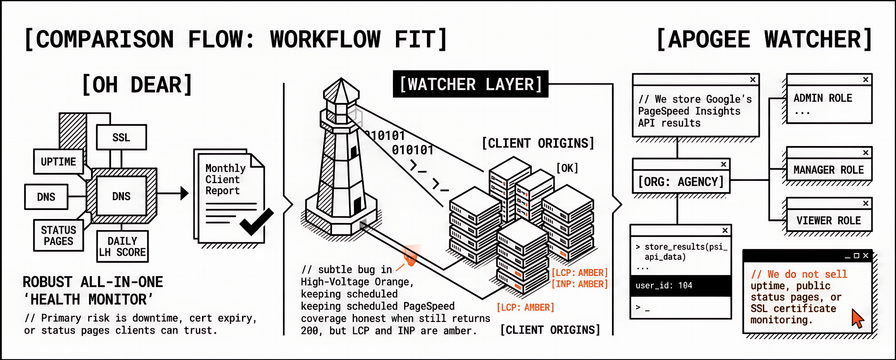
Oh Dear is the tool many agencies use when they want one place for “is the site up?” plus SSL, DNS, broken links, status pages, and a daily Lighthouse score. That package is strong when the primary risk is downtime, certificate expiry, or a status page clients can trust.
Apogee Watcher answers a different question: how do you keep scheduled PageSpeed Insights coverage honest across many client origins when the failure mode is “still returns 200, but LCP and INP are amber,” and when you need multi-tenant roles, discovery, and CrUX context without turning monitoring into a second DevOps product? We store Google’s PageSpeed Insights API results (Lighthouse lab plus CrUX where Google publishes field data) inside organisations with Admin, Manager, and Viewer roles. We do not sell uptime ping suites, public status pages, or SSL certificate monitoring as a product line.
The comparison below is about workflow fit for agencies, not about declaring a universal winner. Feature lists and plan limits change on both sides, so confirm each vendor’s site before you buy and treat any table as a snapshot rather than a contract. Searching for an Oh Dear alternative often mixes two jobs: replace an uptime suite, or keep Oh Dear and add a Core Web Vitals layer. Those are different purchase decisions.
What Oh Dear is genuinely good at
Oh Dear’s public positioning is an all-in-one website health monitor. Marketing copy lists uptime, SSL certificate health, broken links and mixed content, DNS and domain expiry, cron / scheduled-task heartbeats, ping and TCP checks, public status pages, and performance / Lighthouse checks under one login. Every plan includes the full feature set; you pay for site capacity, not for unlocking SSO, unlimited users, or notification destinations (pricing).
For agencies that already lose evenings to “the site is down” tickets, that bundle is compelling. Second-location verification of alerts, branded status pages on your domain, monthly client reports, and reseller-style access are designed so clients see your brand while Oh Dear measures reachability. Teams that want fewer point tools for uptime-adjacent work (and one place to route Slack or PagerDuty) often shortlist Oh Dear for that reason alone.
None of that is theatre. If your brief is “know when client origins fail, certificates expire, or status pages need an update,” Oh Dear is a serious primary candidate. UptimeRobot-class free checkers, StatusCake, and similar products compete on the uptime axis; we are not claiming Watcher replaces that axis.
What Oh Dear performance and Lighthouse checks actually measure
Oh Dear uses the word performance for more than one check, and agencies need the split before they compare it to a PageSpeed programme.
HTTP performance monitoring (documented on Oh Dear performance monitoring) times the same request Oh Dear already makes for uptime. It stores DNS, TCP, TLS, server processing (time to first byte), and content download, then alerts on a millisecond budget or a sudden change against a recent baseline. Samples arrive with the uptime fetch (about once a minute); slowdowns are evaluated on a fifteen-minute cadence. Oh Dear is explicit that this is synthetic, not real-user monitoring, and that it is not a scripted checkout journey.
Lighthouse SEO monitoring (documented on Oh Dear Lighthouse SEO monitoring) runs Google Lighthouse on a schedule (daily in the product story). It tracks performance, accessibility, best-practices, and SEO category scores, then alerts when scores fall below thresholds. That is a real browser lab audit. It is closer to what teams mean by “pagespeed,” and it catches deploys that tank a Lighthouse score overnight.
Those checks sit beside uptime. They do not automatically create a multi-URL Core Web Vitals portfolio with money-page inventories, CrUX field bands beside lab runs, or agency-wide discovery when a client adds twenty new templates. Response-time budgets answer “is the origin late?” Lighthouse answers “did this URL’s lab scores move?” PageSpeed Insights field sections answer “what did Chrome users experience over the collection window?” Mixing those three into one “performance is covered” sentence is how retainers buy the wrong primary tool.
For the wider lab-versus-field map, read When to Use Synthetic vs Real User Monitoring for Performance. For how agencies assemble layers after a tools shortlist, use 3 Agency PageSpeed Stacks for 2026. Together they keep measurement jobs separate from vendor brands.
Where agencies feel friction when CWV is the real job
Oh Dear friction for PageSpeed-led retainers usually shows up in three places, even when the product is excellent at its core job.
Pricing shaped by site count, not by CWV depth. Public Oh Dear pricing scales with sites and servers: 25 sites at Studio $109/month, 50 at Agency $165/month, 100 at Portfolio $275/month. That is predictable when every site needs the full uptime bundle. It is a different equation when you mainly need scheduled mobile and desktop PageSpeed on priority URLs across many hosts, and you already own Pingdom or another uptime tool. Matching “everything included” elsewhere can still mean paying uptime economics for a CWV-only brief.
Performance language that sounds like a CWV suite. HTTP response-time alerts and daily Lighthouse scores are valuable. They are not the same as continuous PageSpeed Insights history with CrUX-in-result context, attention-free triage across a domain, or budgets tied to LCP / INP / CLS thresholds your SEO retainer already uses in client decks. Buyers who search “oh dear vs pagespeed” are often trying to name that gap without a taxonomy.
Portfolio CWV operations. Oh Dear documents grouping client sites, read-only access, and branded reports. Agencies that treat Core Web Vitals as the billable discipline still need URL inventory that keeps up with CMS churn, multi-organisation boundaries, and a monitoring spine that assumes PageSpeed quotas rather than minute-level uptime sampling. Stale URL lists look fine while the live template set has moved on. That inventory problem is why we invested in automated discovery rather than assuming someone pastes every new route.
None of this says Oh Dear is the wrong product. It says the job “uptime + SSL + status pages + daily Lighthouse” and the job “scheduled PSI coverage across a client portfolio” are different purchase decisions. Mixing those jobs on one invoice is where retainer margin usually disappears.
What Apogee Watcher optimises for
We optimise for breadth-first PageSpeed monitoring that agencies can run without per-client Google API keys or an uptime product roadmap:
PageSpeed Insights API results stored over time (lab Lighthouse metrics plus CrUX when Google returns field data for the URL).
Multi-organisation, multi-site structure with Admin, Manager, and Viewer roles.
Automated page discovery from sitemaps and HTML crawl (see how we discover pages).
Performance budgets and email alerts on scheduled runs (Slack and webhook delivery are on the roadmap; confirm live channels on features).
Published tiers from Free through Agency on pricing, with organisation, site, and monthly PageSpeed test quotas pooled at the customer account rather than a surprise per-domain uptime licence for every microsite. Professional is $79/month (25 websites, 2,500 tests/month); Agency is $199/month (unlimited websites, 10,000 tests/month) on the public table at draft time.
Gaps we state plainly: no uptime ping product, no public status pages, no SSL certificate monitor as a first-class feature, no Oh Dear-style mixed-content crawler or cron heartbeat suite. When the pager must fire because HTTPS is down at 02:00, keep Oh Dear, Better Stack, or another uptime vendor on that origin. Claiming otherwise would waste a trial week for both sides.
PDF and white-label report options appear on Professional and Agency on the public pricing table. Confirm what is automated versus manual on features before you promise a fully hands-off branded pack in a pitch. Organisation-scoped prospecting for leads is still largely an internal MVP, so do not assume every agency seat can run prospect workflows in-app until that ships.
For the wider tool taxonomy, use Comparing PageSpeed Monitoring Tools: Features Agencies Need. That checklist stays useful after you shortlist Oh Dear or Watcher. It separates measurement jobs from vendor brands without forcing a pairwise winner on every row.
Oh Dear vs Apogee Watcher: side-by-side
Use this as a decision grid, not a contract. Verify numbers on each vendor’s site before you sign, and re-check after any plan change. Sticker prices move faster than blog posts.
| Topic | Oh Dear (typical public positioning) | Apogee Watcher |
|---|---|---|
| Primary job | Website health: uptime, SSL, DNS, links, status pages, cron, plus performance / Lighthouse | Multi-tenant PageSpeed Insights + Core Web Vitals monitoring |
| Synthetic engine | Minute-level HTTP uptime; HTTP response-time phases; scheduled Lighthouse scores | PageSpeed Insights API (Lighthouse lab + CrUX where available) |
| Real-user / field data | Not first-party RUM; Lighthouse is lab; HTTP timings are synthetic | CrUX in PSI results; no first-party RUM |
| Entry pricing (public list) | Solo from **$17/mo** (2 sites); Freelance **$55/mo** (10); Studio **$109/mo** (25); Agency **$165/mo** (50) ([pricing](https://ohdear.app/pricing)) | Free **$0** (1 website); Personal **$9/mo** (1); Starter **$29/mo** (5); Professional **$79/mo** (25); Agency **$199/mo** (unlimited) ([pricing](https://apogeewatcher.com/pricing)) |
| Billing drivers | Sites and servers; all features on every plan | Organisation, website, and monthly PageSpeed test quota tiers |
| Multi-site / multi-tenant | Client groups, read-only access, reseller options | Organisations, sites, pages, RBAC built for agency portfolios |
| Page discovery | Sitemap monitoring among other checks | Automated sitemap + crawl paths for PageSpeed URL inventory |
| Alerts | Wide notification catalogue (email, Slack, PagerDuty, and more) | Email today; Slack / webhook per roadmap |
| Status pages / SSL / cron | First-class product features | Not a Watcher product line |
| Best day-one use | Know when sites fail, certificates expire, or status needs an update | Portfolio PSI monitoring without client-side scripts |
SpeedCurve and DebugBear occupy the premium synthetic-plus-RUM lane; we compared those separately in SpeedCurve vs Apogee Watcher and DebugBear vs Apogee Watcher. GTmetrix remains useful for deep lab forensics on one URL; see GTmetrix vs Apogee Watcher. None of those comparisons replace an Oh Dear uptime programme, and none replace portfolio PSI schedules on twenty unrelated CMS stacks.
When Oh Dear is the better primary choice
Choose Oh Dear as the primary monitor when:
Uptime, SSL expiry, DNS, domain expiry, or public status pages are non-negotiable for the retainer.
You want one vendor for “is it up?” plus daily Lighthouse scores and HTTP response-time budgets, with every feature unlocked on the plan you buy.
Clients expect branded status pages or monthly reports that prove independent reachability checks.
Your team already routes incidents to Slack, PagerDuty, or Opsgenie and needs those destinations on day one.
In those cases an “Oh Dear alternative” search often ends with staying on Oh Dear, or pairing it with a cheaper PageSpeed layer rather than ripping out the uptime suite.
When Apogee Watcher is the better Oh Dear alternative for PageSpeed
Choose Watcher as the primary portfolio layer when:
The expensive failure mode is Core Web Vitals and PageSpeed regressions across many client hosts, not minute-level downtime alone.
You need scheduled mobile and desktop PSI runs with CrUX context, without placing RUM snippets or maintaining per-client Google API keys.
Oh Dear site-capacity pricing for a large roster would fund an uptime bundle you already cover elsewhere, while CWV reporting is still thin.
Multi-organisation roles, automated discovery, and attention-free triage on domain reports matter more than status-page branding.
Under-$100 agency maths for multi-tenant PSI is covered in Affordable Multi-Tenant Performance Monitoring Under $100/Month. Reach for that guide when the budget conversation is the blocker. Reach for this Oh Dear comparison when the blocker is uptime-suite versus CWV-suite fit instead.
When to run both (layer, do not replace)
Many agencies should not pick a single winner. Uptime and Core Web Vitals are different jobs that share URLs and quarrel over invoices. A clean split looks like this:
Keep Oh Dear (or another uptime suite) on money origins for reachability, certificates, and status communication.
Run Watcher schedules on the same priority URLs for Lighthouse lab history, CrUX-in-PSI field bands, budgets, and portfolio alerts.
Treat Oh Dear’s HTTP response-time check as an early “origin feels late” signal, then use PSI / CrUX to explain whether users and search actually saw a CWV shift.
Leave daily Oh Dear Lighthouse on as a lightweight score watchdog if you like the alert destinations; do not pretend it replaces a multi-page PSI programme with discovery.
That is the same “layer, don’t replace” rule we use across the comparison cluster. Rip-and-replace only makes sense when one product already owns the job you are buying. For most retainers, forcing a single vendor to cover both uptime and CWV is how invoices get padded without clearer alerts.
FAQ
Is Apogee Watcher an Oh Dear alternative?
Yes for PageSpeed and Core Web Vitals portfolio monitoring. No as a drop-in replacement for uptime, SSL, status pages, cron, or DNS monitoring. If those checks are why you opened Oh Dear, keep them.
Does Oh Dear already do PageSpeed?
Oh Dear runs scheduled Lighthouse audits and HTTP response-time monitoring. That overlaps with “pagespeed” language in buying conversations. It is not the same product shape as continuous PageSpeed Insights portfolio monitoring with CrUX storage, multi-tenant discovery, and CWV budgets across many clients.
How does Oh Dear pricing compare at 25 or 50 sites?
At draft time, Oh Dear Studio is $109/month for 25 sites and Agency $165/month for 50, with all features included (ohdear.app/pricing). Watcher Professional is $79/month for 25 websites and 2,500 PageSpeed tests/month; Agency is $199/month for unlimited websites and 10,000 tests/month (apogeewatcher.com/pricing). Compare apples to apples: Oh Dear’s site price buys the uptime suite; Watcher’s tier buys PSI quota, organisations, and website caps on the same account. Re-check both pages before you sign.
Can we use Oh Dear Lighthouse and Watcher together?
Yes. Daily Lighthouse score alerts and portfolio PSI history answer different operational questions. Use Oh Dear when the score drops; use Watcher when you need money-URL inventories, CrUX context, and agency roles across the book of business.
What about free uptime tools instead of Oh Dear?
Free uptime tiers can cover a handful of URLs. They rarely match Oh Dear’s bundled SSL, status pages, and agency reporting story. They also do not solve CWV portfolio monitoring. Stack choices after price filters are in 3 Agency PageSpeed Stacks for 2026.
Pick the job, then the invoice
If the pager must fire when a client origin is unreachable, start with Oh Dear or another uptime suite and verify Oh Dear pricing against your site count. If the monthly deck must explain Core Web Vitals across many hosts, start with Watcher’s pricing and a trial on the money URLs you already report. If both jobs are real, layer them and stop forcing one vendor to pretend it is the other.
Start a free Watcher trial when you want scheduled PageSpeed coverage without ripping out the uptime stack you already trust. For the feature checklist beyond this pairwise split, keep Comparing PageSpeed Monitoring Tools: Features Agencies Need open while you shortlist. It remains the taxonomy map after the Oh Dear decision is settled.
References
Oh Dear pricing (Oh Dear)
Oh Dear performance monitoring (Oh Dear)
Oh Dear Lighthouse SEO monitoring (Oh Dear)
Apogee Watcher pricing (Apogee Watcher)
Comparing PageSpeed Monitoring Tools: Features Agencies Need (Apogee Watcher)
When to Use Synthetic vs Real User Monitoring for Performance (Apogee Watcher)
3 Agency PageSpeed Stacks for 2026 (Apogee Watcher)
Affordable Multi-Tenant Performance Monitoring Under $100/Month (Apogee Watcher)
SpeedCurve vs Apogee Watcher (Apogee Watcher)
DebugBear vs Apogee Watcher (Apogee Watcher)
GTmetrix vs Apogee Watcher (Apogee Watcher)
How Apogee Watcher discovers pages automatically (Apogee Watcher)


