In late May and early June, we shipped the public free domain PageSpeed check, tightened how customer plans cap organisations, and added redirect tooling so old blog URLs resolve cleanly. We also published the redirect module as an open-source Laravel package, listed recent changelogs on the app dashboard, and fixed a handful of layout issues on the marketing site.
Free domain PageSpeed check at /check
Changelog #9 added domain roll-up reports to monitored sites inside customer organisations. In late May, we extended that reporting engine to a no-signup funnel on the public site.
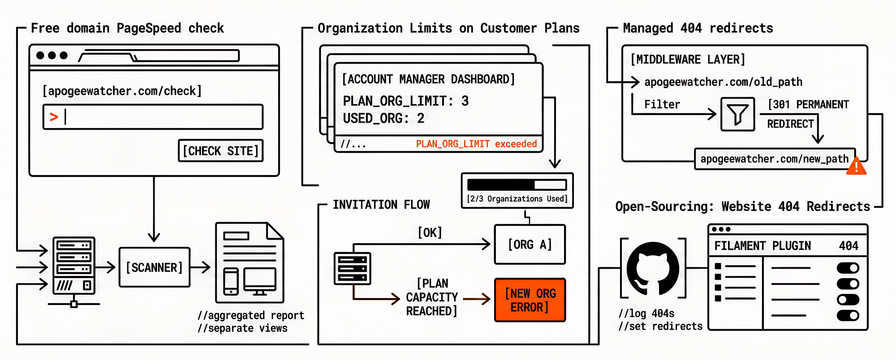
Anyone can open apogeewatcher.com/check, enter a hostname, review discovered pages, and start a multi-page scan. Watcher runs PageSpeed Insights-backed tests in the background, then emails a link to one aggregated domain report you can share. Mobile and desktop stay separate in the summary, matching the layout paying customers already see for domain reports on monitored sites.
If you create an account after a scan, you can import the run into monitoring so scheduled tests and performance budgets continue from the same URLs instead of starting discovery again.
We also fixed error messaging when a scan cannot start, and tightened form layout on the check pages and audience feature screens so the hero domain field behaves on narrow viewports.
Organisation limits on customer plans
Agency subscriptions often cover more than one client organisation. Plans now store a maximum organisation count, enforced when you create a new organisation or accept an invitation.
The plan usage widget on the dashboard and My Account shows how many organisations and sites you are using against those caps. Pricing copy and the subscription view in the app reflect the same numbers, so account managers can see when a plan upgrade is needed before they reach the cap.
Provisioning when you accept a prelaunch invitation respects the limit as well: if the subscription is already at capacity, the flow tells you plainly instead of creating a half-configured organisation.
Managed 404 redirects for the public site
We added redirect management so legacy blog paths or misconfigured links on apogeewatcher.com resolve with permanent redirects when slugs change or old URLs still get traffic.
A middleware layer applies those rules on each request, with caching so repeat hits stay fast. We seeded redirects for older blog URLs so bookmarks and external links from earlier posts still resolve to the current slug. Bulk actions on the redirect list make it easier to retire or repoint several paths after a content import.
Open-sourcing Website 404 Redirects
The same redirect pattern we run on apogeewatcher.com was initially developed as an in-app module on client Laravel projects. When a site gets restructured, old paths return 404, fixes end up scattered across nginx, .htaccess, and route files, and every correction needs a deploy. We extracted the module into a focused package and published it on GitHub as Website 404 Redirects.
The package logs unmatched public GET and HEAD requests with hit counts and timestamps, serves 301 redirects from a database table before routing runs, and caches the redirect map so repeat hits stay fast. Configurable exclusions keep admin, API, and asset paths out of the hit table. An optional Filament plugin lets content editors review broken URLs and set redirects without asking for a release.
We wrote up the background and install steps in Open-sourcing Website 404 Redirects: database-driven 301s for Laravel. The scope is deliberately narrow: log what is breaking, fix it in the database, serve the redirect on the next request. It sits alongside PageSpeed Watcher in our open-source portfolio: production code we publish when it is stable enough to share.
Changelog posts on the dashboard
Logged-in users now see a System Updates table on the app dashboard. It lists the three newest published posts tagged changelog, with dates and links to the public blog. The widget uses the same ordering as https://apogeewatcher.com/blog/tag/changelog, so product news in the app matches what we publish on the site.
We removed an awkward scrollbar from that widget and adjusted plan usage and latest-test widgets nearby so the dashboard row lays out without overlap on smaller laptop screens.
What to try
Run a domain through apogeewatcher.com/check before your next client call and compare the emailed report with a roll-up from a site you already monitor. If you manage several client organisations on one subscription, open My Account and confirm organisation usage against your plan cap.
The rest of June will focus on comparison and onboarding content on the blog, plus continued polish on domain reporting inside customer accounts.